Lessons 2 · Using your camera
Full frame and APS-C
Interchangeable-lens cameras come with three common sensor sizes:
- Full frame: 36 × 24 mm, the size of a 35 mm film frame.
- APS-C: about 23.5 × 15.6 mm. Its diagonal is about 1.5 times shorter.
- Micro Four Thirds: 17.3 × 13 mm, half the diagonal of full frame.
That ratio is the crop factor. A smaller sensor sees only the middle of the image the lens projects, so the same lens gives a narrower view, as if you had cropped a full-frame photo. It also changes depth of field and noise, which is why sensor size matters for more than the price.
Equivalent focal length
A lens's focal length never changes, but the view it gives does. To compare, people quote the full-frame equivalent:
| Lens | On APS-C, looks like | On Micro Four Thirds, looks like |
|---|---|---|
| 16 mm | 25 mm | 32 mm |
| 23 mm | 36 mm | 46 mm |
| 35 mm | 54 mm | 70 mm |
| 50 mm | 77 mm | 100 mm |
| 85 mm | 131 mm | 170 mm |
This is why APS-C kit lenses start around 16-18 mm (a 24-27 mm view), and why small-sensor cameras are popular for wildlife: a 300 mm lens frames like a 450 or 600 mm.
Equivalent aperture: depth of field and noise
To get the same framing on a smaller sensor, you use a shorter lens. A shorter lens at the same f-number has a smaller physical opening, so it gives more depth of field. For the same picture, multiply the f-number by the crop factor too:
- An APS-C camera with a 33 mm f/1.4 lens frames like a full-frame 50 mm and blurs the background like f/2.1 on full frame.
- A Micro Four Thirds 25 mm f/1.7 frames like 50 mm and blurs like f/3.4.
The f-number still sets the brightness: f/2.8 is f/2.8 on any sensor, and the shutter speed and ISO stay the same. But the smaller sensor collected less light in total, because it has less area. The simulated APS-C sensor has 1.2 stops less area than full frame, so at the same settings, with photos viewed at the same size, it shows about 1.2 stops more noise.
Pixel size: full frame 24 MP has 6.0 µm pixels, APS-C 26 MP has 3.8 µm.
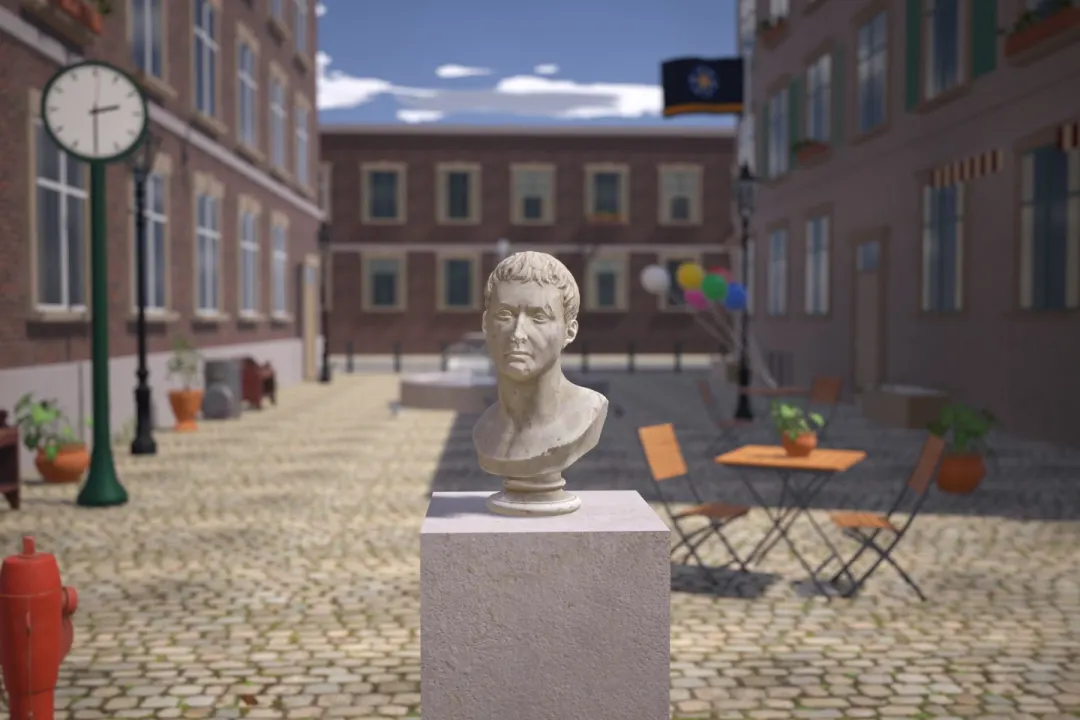
Try this: Switch between full frame and APS-C with the same 35 mm lens. The APS-C frame is tighter, like a 52 mm lens on full frame. Compare the background blur at f/1.8.
Which one suits you
| Full frame | APS-C | Micro Four Thirds | |
|---|---|---|---|
| Low light and noise | Best | Good | Fair |
| Background blur | Easiest | Good with fast primes | Needs very fast lenses |
| Size, weight, price | Largest | Middle | Smallest |
| Telephoto reach | Big lenses | Extra reach | Most reach for the size |
For most people, the camera that comes with them is better than the one that stays at home. Lenses also matter more than the sensor: a fast prime on APS-C beats a slow kit zoom on full frame for portraits and low light.